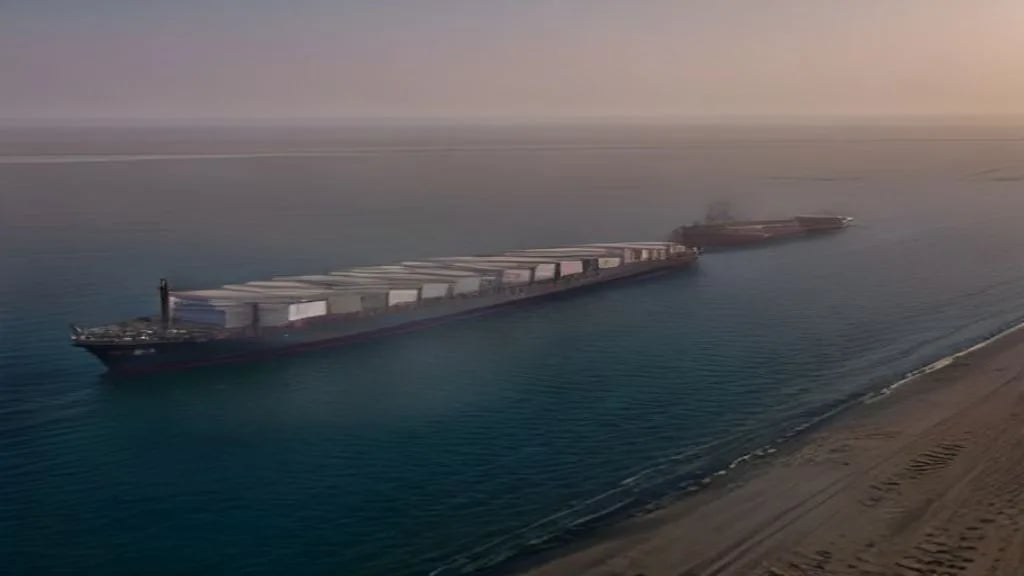
Mile after mile of sand and water, the Suez Canal remains the busiest man-made trade artery ever built: 193 kilometres carved into the Egyptian desert carrying roughly 12% of world trade and 30% of global container traffic. In an age of air freight and digital networks, the price of the goods reaching Europe and Asia is still set here, where the waterway narrows to little more than 200 metres in places.
A convoy of ships along 193 kilometres
The canal links Port Said on the Mediterranean to Suez on the Red Sea. It runs 193.30 kilometres, is 24 metres deep and at least 205 metres wide. Geometry is everything: rounding Africa via the Cape of Good Hope adds roughly 3,500 nautical miles, up to two weeks of sailing and more than $1 million in extra cost per vessel, between fuel, crew and insurance.
For scale: about 19,000 ships used the route in 2020, fifty a day. In March 2021 the container ship Ever Given ran aground and blocked the canal for six days; Lloyd's List estimated each day of the blockage held up $9.6 billion worth of goods.
A strategic asset born in 1869
Inaugurated on 17 November 1869 under Khedive Isma'il Pasha, the canal instantly became a first-order geopolitical asset. In 1875 a cash-strapped Egypt sold its 44% stake to the United Kingdom for £4 million. In July 1956 President Gamal Abdel Nasser nationalised the waterway, triggering the Suez Canal Crisis of October-November that year.
The corridor's vulnerability then returned in cycles: closed on 5 June 1967 after the Six-Day War, it stayed shut for eight years until its reopening on 5 June 1975. And in 2021 the Ever Given showed that a single hull can hold the world's main trade artery hostage for a week.
Since 2023, the challenge is reaching Suez
The vulnerability today lies not inside the canal but on the way to it. From 2023 onward, Houthi attacks in the Red Sea pushed many carriers to divert around Africa, and the fallout for Egypt was severe: canal revenue, after peaking at a record $9.4 billion in 2023, fell to $3.9 billion in 2024, with transits down 50% and cargo traffic down 64%.
2026: with Hormuz shut, Suez fills up again
2026 has flipped the picture. With the Strait of Hormuz crippled, part of Saudi crude is piped to the Red Sea port of Yanbu and then reaches the Mediterranean through Suez: in the second quarter tankers accounted for 1,526 of the canal's 3,580 transits, nearly 43% of the total, with tanker traffic up 22.3% year on year. Q2 2026 revenue rose to $1.26 billion, up 13% on the previous quarter; for the full 2025/26 fiscal year the canal authority reports $4.67 billion, up 23%.
The recovery now extends to containers too. Maersk estimates that more than 30% of the Asia-Europe volumes it had shifted around the Cape of Good Hope have already returned to the Suez route, and since early July it has moved four services back: AE19, AE15, MECL and WAF6. MSC has quietly sent at least seven ships through without any announcement, switching off their AIS transponders along the riskiest stretch. For the Egyptian government it is the first sign of a climb the canal authority projects to $10 billion by fiscal year 2027/28.
Piracy and maritime cold war: the brakes on the rebound
The recovery remains fragile. Attacks in the Red Sea continued through July and August, piracy off Somalia is at a ten-year high, with 13 incidents from January to July against 5 in all of 2025, and the 20 August seizure of the tanker Sibu 1 showed the corridor is still exposed. Drewry warns that the return of Asia-Europe loops depends on how the Hormuz crisis unfolds, and the industry fears a capacity side-effect: if too many services return to Suez at once, the ships freed from long detours would pile onto a market already saturated with new deliveries.
A corridor under watch, 150 years on
More than 150 years after its inauguration, the canal keeps exposing globalisation's paradox: world trade, imagined as capillary and redundant, still depends on a thin ribbon of water carved out of the desert. As long as Hormuz stays shut and the Red Sea remains on alert, the Egyptian corridor lives a contradiction: it is the shortest passage between Asia and Europe, and the easiest one to avoid.
Sources