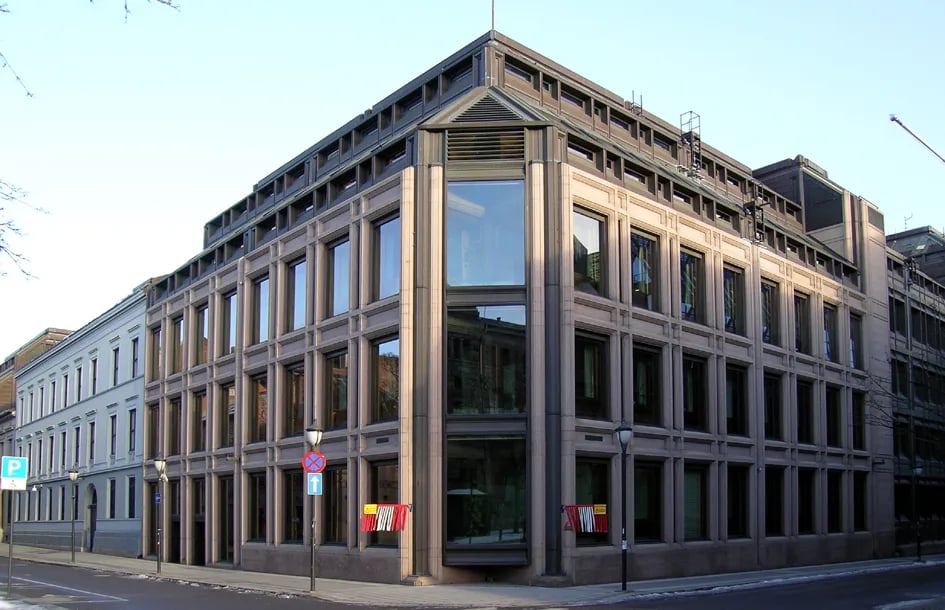
On 23 September 2026, Norway's central bank raised its policy rate by 25 basis points to 4.50%, the latest in a series of tightening moves driven by persistent inflation well above target. Hours later, the Swiss National Bank held its rate at 0%, arguing that moderate price pressures and a supportive exchange rate policy were sufficient to keep Swiss inflation within bounds. The two decisions, arriving on the same day, crystallise how differently European monetary authorities are responding to the same global shock: war-driven energy costs.
Norges Bank: higher for longer
The Norges Bank committee judged that "a somewhat tighter monetary policy stance is needed to return inflation to target within a reasonable time horizon," according to the press release published on 24 September. The decision was unanimous. Governor Ida Wolden Bache noted that inflation has been above Norway's 2% target for several years and that the committee is "prepared to raise the policy rate further if needed."
Headline CPI reached 3.3% year-on-year in August, driven higher by energy prices, while the underlying measure — CPI adjusted for tax changes and excluding energy products (CPI-ATE) — stood at 3.0%. Both figures remained markedly above the 2% target. The committee flagged that rapid business cost increases over recent years could keep inflation elevated and risk embedding inflation expectations, making future disinflation harder.
The new policy rate path published alongside the decision shows rates staying near 4.50% for longer than previously projected. Inflation is forecast to decline gradually from 2027 and reach 2% only in 2029. The committee acknowledged that a stronger Norwegian krone — up since June — would dampen imported goods inflation, but said this would be partly offset by rising global commodity prices linked to the Middle East conflict. Capacity utilisation has drifted below normal levels, and unemployment is expected to edge higher, but the committee judged that the risk of persistent inflation outweighed the cost of additional monetary restraint.
Swiss National Bank: on hold at zero
The SNB, in its assessment published the same day, left the policy rate at 0% and reiterated its willingness to intervene in foreign-exchange markets as necessary. Swiss consumer price inflation rose to 0.8% in August from 0.6% in May, a modest increase driven almost entirely by higher oil product prices. The SNB's conditional inflation forecast projects 0.7% average annual inflation for 2026, 0.8% for 2027, and 0.8% for 2028 — well within the price stability range.
The contrast with Norway is stark. Where Norwegian inflation sits 1.3 percentage points above target, Swiss inflation barely registers above zero. The SNB noted that goods inflation turned positive in August for the first time since May 2024, but said medium-term inflationary pressure had increased only slightly. Global growth surprised to the upside in the second quarter, and the SNB projects Swiss GDP growth of 1.5% to 2.0% for 2026, with solid but broad-based domestic demand.
The SNB's assessment identified the same geopolitical risks as its Norwegian counterpart — the Middle East conflict, trade policy uncertainty, and energy price volatility — but concluded these did not yet warrant a rate change. A weaker Swiss franc had added to imported inflation, but the SNB viewed this as manageable within its existing toolkit.
Why it matters
The twin decisions expose a structural divide in European monetary policy. Norway, as a major oil and gas exporter, faces a more complex inflation picture: strong export revenues and a tight labour market push up domestic costs even as the krone's appreciation provides some relief. The SNB, by contrast, operates in an economy where deflationary pressures have only recently given way to near-zero inflation, and where the primary policy lever remains exchange-rate management rather than interest rates.
For markets, the divergence signals that there is no single European response to the current inflation shock. Norwegian rates are now among the highest in the region, while Swiss rates remain at the floor. The gap — 450 basis points — is unusually wide for two neighbouring economies and reflects fundamentally different structural conditions rather than a simple hawkish-dovish split.
The next Norges Bank decision is scheduled for 5 November 2026. The SNB's next monetary policy assessment is due in December.
Sources
- Norges Bank, "Policy rate raised to 4.50%", 24 September 2026. norges-bank.no
- Swiss National Bank, "Monetary policy assessment of 24 September 2026", 24 September 2026. snb.ch
- Reuters, "Norway central bank raises interest rate, may hike again", 24 September 2026. reuters.com