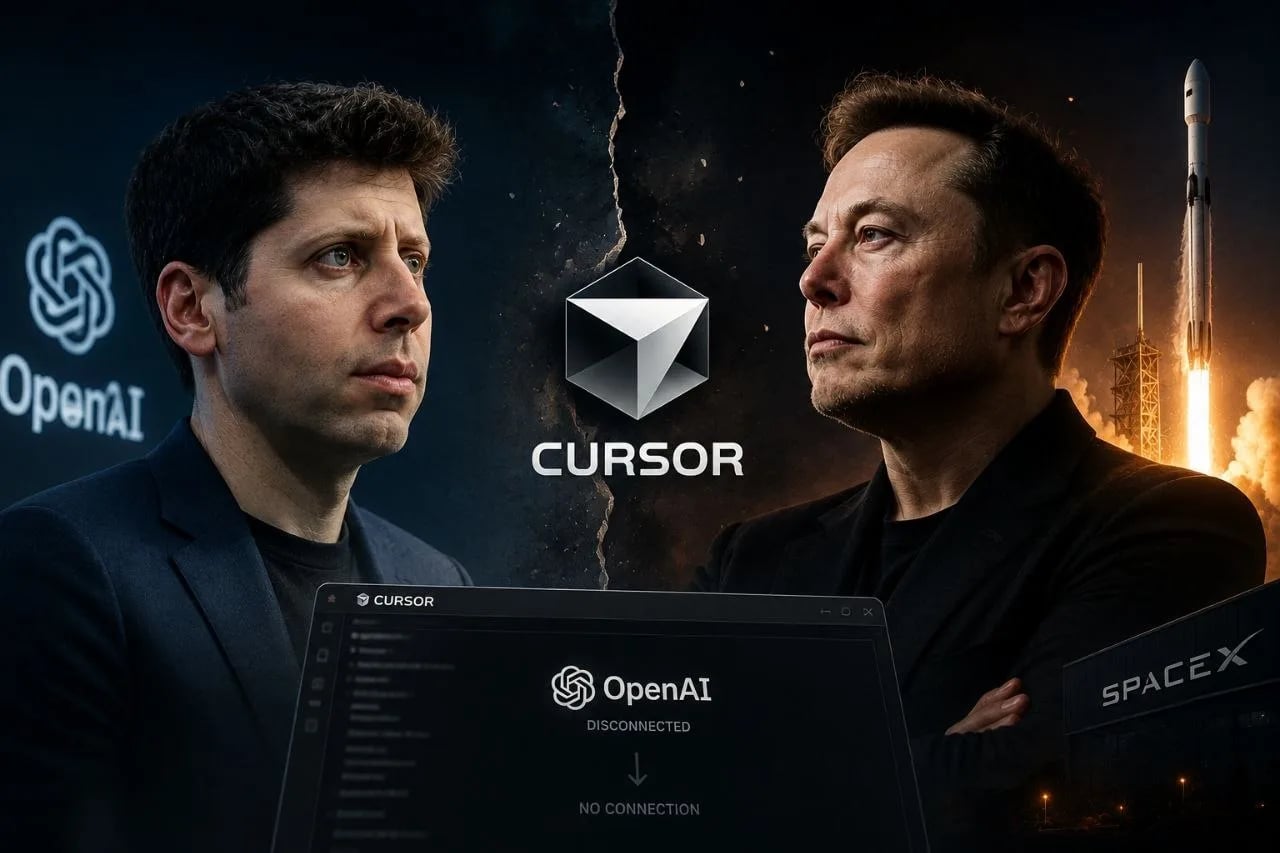
Two weeks after SpaceX's acquisition of Cursor, completed on August 14 in an all-stock deal worth $60 billion, OpenAI has decided to cut the AI coding tool's access to its models. The disconnection will take effect on November 12, the deadline for developers to choose an alternative provider.
Cursor is one of the most widely used AI coding assistants among software developers, and its collaboration with OpenAI goes back years: the platform was one of the very first customers of Sam Altman's company, which long treated it as neutral infrastructure for its business.
The mechanism: the change-of-control clause
OpenAI never claimed that Cursor did anything wrong. To exit the partnership it invoked a change-of-control clause, the contractual provision that allows one party to walk away from an agreement when the other is acquired. The stated reason is trust: OpenAI says it cannot be sure that SpaceX, the new owner, will follow its rules.
Two precedents were cited to support the decision. The first concerns X, the social platform Elon Musk bought in 2022 and later folded into SpaceX's orbit, which had already violated a previous contract with OpenAI. The second is even more sensitive: on April 30, in a California courtroom, a lawyer asked Musk whether xAI had distilled OpenAI's models to train Grok, its rival model. Distillation means repeatedly prompting a rival model to copy what it knows. Musk initially replied that every AI company does it, but under further pressure admitted that xAI had done so at least in part. Musk was testifying in his own lawsuit against OpenAI, which a jury dismissed three weeks later because it had been filed too late.
The Astra condition and the reactions
OpenAI added one further condition: Astra, its next flagship model, will never be available through Cursor. Michael Truell, Cursor's co-founder now employed at SpaceX, put the damage at roughly 5% of the platform's user traffic and confirmed that talks with OpenAI are still ongoing. According to Truell, "Cursor was one of the very first users of OpenAI, we worked closely with their team for years and we relied on their platform as neutral infrastructure for our business."
Elon Musk's reaction leaves no room for negotiation: in his initial response he said he "couldn't care less," calling Altman and OpenAI president Greg Brockman untrustworthy.
Anthropic has moved in the opposite direction. Co-founder Tom Brown announced increased computing power to make Claude run better on Cursor: "Cursor has been a reliable partner of Anthropic since the launch of Sonnet 3.5. We will keep increasing compute to support the Claude models on Cursor and we are excited about what lies ahead with them inside SpaceX," Brown wrote in a post published on Saturday morning.
What is at stake is not revenue: OpenAI is not defending the 5% of sales generated by a single customer, it is refusing to sell its services to Musk. Developers have until November 12 to migrate to other providers, and Cursor already offers the Grok, Claude and Gemini models.
Sources